
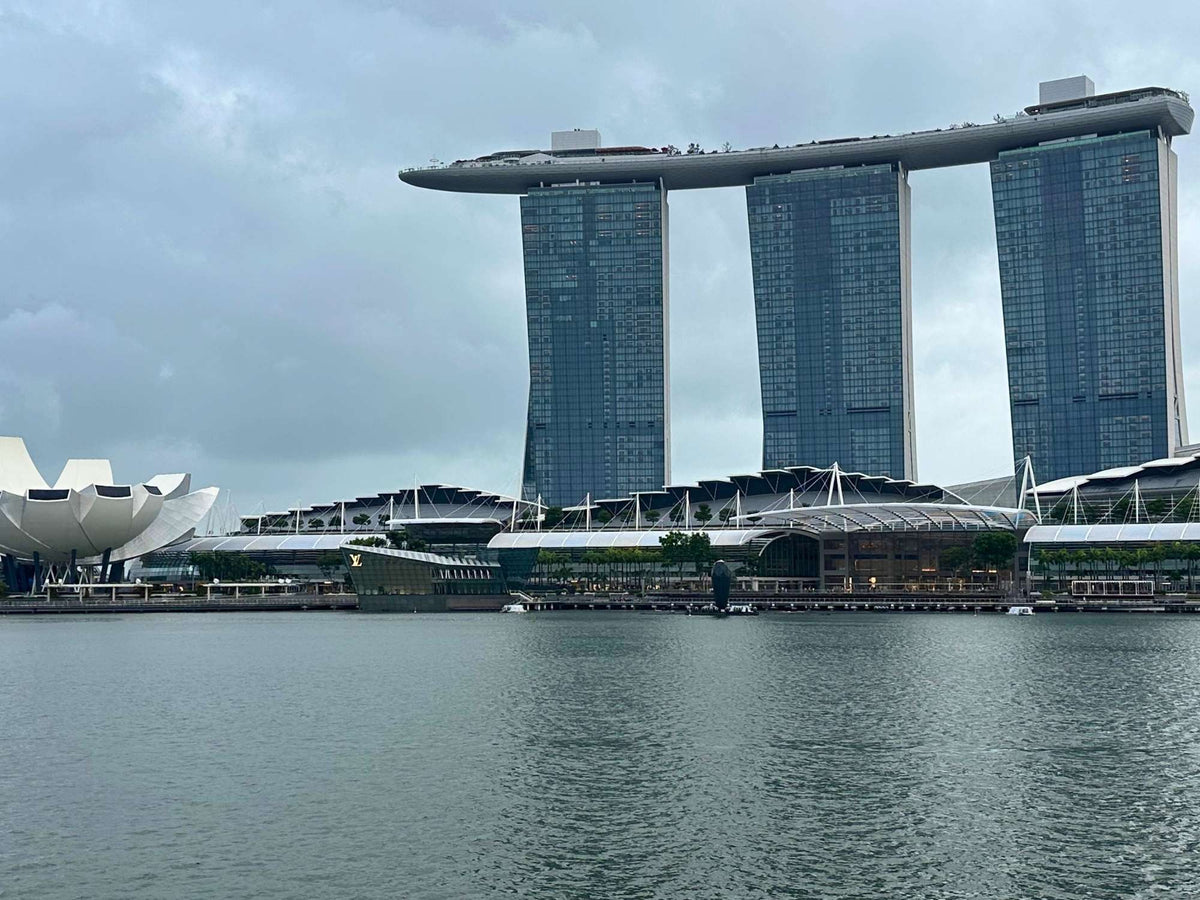
Marina Bay rewards a walk more than a single photograph. From one side, Marina Bay Sands stretches across the skyline. Move closer and its familiar outline becomes an exercise in scale. Turn back toward the city after dark, and the office towers across the water become the view.
During our first visit to Singapore in January 2026, we returned to the bay several times over a week. We came at midday, in the afternoon and in the evening, under a mix of sunshine and clouds. Each visit gave us another way to look at the same place.
This is our guide to the views that stayed with us, the architecture worth slowing down for, and how those impressions developed into three Spicy Lotus designs.
Editorial note: Our observations come from visits in January 2026. Walking access, construction and event arrangements can change. Check current local information before setting out. Our building impressions are primarily from outside; we entered the Apple store and The Shoppes at Marina Bay Sands.
Our visits at a glance
- When: Several visits during a week in January 2026
- How we explored: On foot, approaching from different parts of the city
- Time spent: Around one to two hours on individual walks around the bay and nearby gardens; longer approaches were separate
- Favorite views: Merlion Park toward Marina Bay Sands, the waterfront outside The Shoppes toward the city at night, and Marina Barrage toward the wider skyline
- What surprised us: The balance between large buildings, open water and room to pause
- Our advice: Change your viewpoint, stop regularly and return after dark if you can
Why the waterfront changes how you see the architecture
Our first impression was of space. The buildings were impressive, but the open water gave us enough distance to take them in.
To us, the bay felt balanced: the skyline, water and open areas worked together. Our eyes could travel across the scene before settling on a particular building. That sense of room was as memorable as any individual landmark.
As we walked, buildings overlapped differently, reflections entered the picture and familiar shapes appeared from unexpected angles. A view that had felt like one complete composition became something else a few minutes later.
That is why we would recommend walking around the bay rather than choosing just one place to photograph it.

The buildings that held our attention
Marina Bay Sands: a familiar outline with an unexpected scale
Marina Bay Sands was the building that most strongly changed our sense of proportion. Across the water, its three towers and long rooftop form are easy to read as a single silhouette. Close up, the height and breadth become much harder to fit into one glance.
The resort was designed by Moshe Safdie. Its three hotel towers and rooftop SkyPark are central to that recognizable shape. The resort’s architecture guide provides further background.
Our strongest memory was looking up at it from the Gardens by the Bay side, close to the building. We already knew what it looked like from photographs. Standing below it made its sheer size feel new.
If you have only seen it across the bay, try a closer viewpoint too. The distant outline and the view from below offer very different experiences.
ArtScience Museum: a sculptural counterpoint
The ArtScience Museum caught our attention for a different reason. Its curved, outward-reaching form stood apart from the surrounding towers.
The museum describes its architecture, also designed by Moshe Safdie, as inspired by a lotus in bloom. That context helps explain its sculptural shape, although simply watching its silhouette change as you move is rewarding in itself. ArtScience Museum’s architecture
We viewed it from outside. What interested us was how its lower, curving form created a contrast with Marina Bay Sands nearby.
The waterfront Apple and Louis Vuitton buildings
The Apple and Louis Vuitton stores also stood out because of their position out over the water and their distinctive forms.
Apple’s glass dome reads almost like a sphere resting on the bay. Designed with Foster + Partners, it offers panoramic views from its waterfront setting. Apple’s introduction to the store
We went inside Apple and The Shoppes, while our impression of the Louis Vuitton building remained an exterior one. Together, these smaller waterfront structures gave us another reason to look beyond the hotel towers.
Elsewhere around the bay, we also took in the Esplanade, Helix Bridge, Fullerton Hotel and Merlion. The Merlion was the unexpected detail: in person, it felt much smaller than we had imagined from photographs.
Three viewpoints we would return to
Merlion Park: looking across to Marina Bay Sands
From the Merlion side, we enjoyed the broad view across the water toward Marina Bay Sands. It gave us room to appreciate the building’s outline and its relationship with the surrounding waterfront.
Pause here before concentrating on individual details. The space between you and the buildings is part of what makes the view work.
Outside The Shoppes: looking back at the city at night
One of our favorite evening views was from the waterfront near the Spectra light and water show, looking toward the city opposite.
We stayed for the show, but the illuminated skyline beyond it was a highlight in its own right. Turning away from Marina Bay Sands put the denser city skyline at the center of the scene.
This is the view we would suggest to anyone who has photographed the hotel and is ready to see the bay differently.
Marina Barrage: a wider perspective
Marina Barrage offered another memorable view, with more distance and a broader sense of the city’s setting. We liked it as a place to linger, take photographs or plan a picnic.
Singapore’s water agency, PUB, also identifies the Green Roof as a place for skyline views and picnicking. See its Marina Barrage information when planning a visit.
Treat this as an extension to your bay walk, rather than assuming it fits into a short waterfront circuit.

How we would approach the walk
We reached the bay from several directions: through the civic area near the National Gallery and Anderson Bridge, from Chinatown and the central city, and on a longer approach from Geylang via Marina East, Marina Barrage and Gardens by the Bay.
That longer approach gave us views we would otherwise have missed, but it will be more walking than many visitors want. The Marina East stretch we encountered in January 2026 was heavily affected by construction. That is a record of our visit, not a statement about current conditions.
For a first visit, we would focus on the central waterfront and leave time to stop. On our walks, benches, garden areas and The Shoppes provided opportunities to sit down, find shade or cool off.
A few things we would do again:
- Look at major buildings from both across the water and close by.
- Pause between landmarks instead of treating the walk as a checklist.
- Return in the evening to see how lighting changes the scene.
- Allow extra time for Gardens by the Bay or Marina Barrage.
- Bring water and check the weather before a longer walk.

How Marina Bay became three Spicy Lotus designs
The series grew out of our experience of the bay rather than one photograph.
What we wanted to retain was the overall composition: recognizable architecture, a generous stretch of water and the feeling that a large city could be energetic and surprisingly calm at the same time.
The artworks were developed with AI assistance from our descriptions and creative direction. They are freely composed interpretations: building positions, proportions and viewpoints do not reproduce the waterfront exactly.
Calm Daylight
Calm Daylight focuses on the ease we felt around the bay. We wanted brightness and a welcoming mood, with room for the eye to rest despite the scale of the city.
The water matters as much as the buildings. It preserves the sense of openness that stood out to us during our walks.
Serene Sail
Serene Sail explores that quieter impression through the contrast between an old-style sailing boat and a modern skyline.
The boat introduces a slower visual rhythm. It is an artistic choice that expresses the calm we associated with the waterfront.
Modern Energy
Modern Energy turns toward the city’s more energetic side. Strong blocks of teal, yellow and pink, graphic shapes and textured surfaces bring a more abstract treatment to the recognizable skyline.
The three works belong together because they explore different readings of one place: its openness, its calm and its metropolitan energy.
Take time to see the view change
What stayed with us was the experience of moving around the bay. We could recognize the same landmarks and still find a new composition each time we stopped.
If you visit, give yourself time for that change. Look across the water, walk closer, turn around and look back. The familiar skyline becomes more interesting when you let it become more than one view.
Frequently asked questions
Are Marina Bay and Marina Bay Sands the same place?
Marina Bay is the waterfront area explored here. Marina Bay Sands is the resort with the three hotel towers, one of the landmarks beside it.
Should you visit Marina Bay during the day or at night?
We enjoyed both. Daylight gave us clear views of the buildings and the wider setting; evening lighting changed the atmosphere and made the opposite city skyline especially memorable.
How long should you allow for an architecture walk?
Our individual walks around the bay and nearby gardens lasted around one to two hours. Allow more time for frequent stops, going inside buildings or extending the walk to Marina Barrage. This is not a timed route for every place mentioned.
Do the posters show exact views of Marina Bay?
No. They are artistic compositions inspired by our visits. They combine recognizable landmarks with changes to perspective, scale and arrangement.
First-hand visits: January 2026. Architecture and source review: September 6, 2026.


