
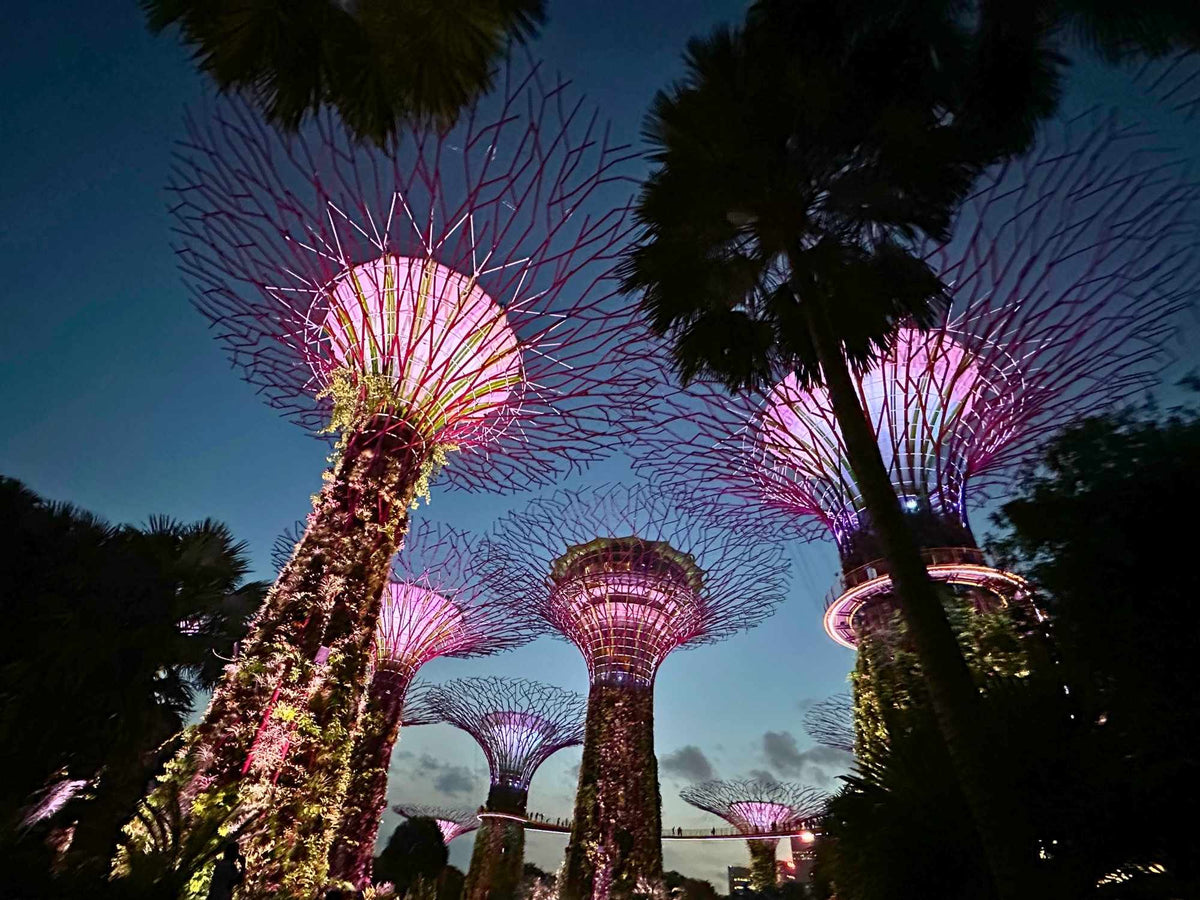
By day, we found ourselves looking at the plants. By night, we could barely look away from the lights.
That difference is what made the Supertrees at Singapore’s Gardens by the Bay so memorable. The structures were the same, but the experience changed completely: greenery gave way to illuminated silhouettes, and music turned individual trees into parts of a much larger performance.
We watched the Garden Rhapsody light show on January 10 and 11, 2026. One evening was not enough.
For anyone planning a visit, the appeal goes beyond a colorful photograph. Here is what the show felt like, how we approached our evenings, and why the relationship between nature, architecture and light makes the Supertrees such a compelling subject for design.
Editorial note: Our personal observations come from visits in January 2026. Practical information was checked in September 2026. Show schedules, programs and access arrangements may change, so check the official venue information before visiting.
Gardens by the Bay light show: the essentials
The Supertree light and music show is called Garden Rhapsody, and it takes place at Supertree Grove.
At the time of checking, the official schedule lists performances at 7:45 p.m. and 8:45 p.m. daily. Admission is normally free, although ticketed events such as Christmas Wonderland can affect access to the grove. Always check the official Garden Rhapsody page for your dates.
For our two January visits:
- We watched from ground level.
- We did not pay or make a reservation.
- We arrived around an hour before the performance.
- The area became very busy, but we had a good view.
- Both shows started on time, with no weather-related disruption.
Arriving that early was our choice to secure a comfortable spot and enjoy the surroundings—not an official requirement.
What are the Supertrees, beyond the lights?
From a distance, the Supertrees look like something imagined for a future city. Up close, their planting becomes part of the story.
They are vertical garden structures rather than ordinary trees. Supertree Grove contains 12 of the Gardens’ 18 Supertrees, with the tallest reaching 50 meters. Their planted surfaces support species including orchids, ferns and tropical climbers, while some Supertrees also incorporate solar-energy technology. You can read more about their structure and planting on the official Supertree Grove page.
During our daytime visits, it was the greenery that held our attention. Looking closely gave us a different appreciation of structures we had previously associated mainly with dramatic nighttime photographs.
That is one reason to see the grove before dark if your schedule allows. The evening show is spectacular, but the planting helps explain why these structures belong in a garden rather than simply on a skyline.

What the light show actually felt like
The strongest moment came right at the beginning.
Even after seeing photographs and videos, we were not prepared for how much the scene would change once the performance started. Suddenly, the trees were not simply illuminated objects. They seemed to respond to one another.
For our January dates, the program was Garden Waltz, which the venue listed for January 2–31, 2026. Its waltz music matched our recollection of a rhythmic, carefully coordinated performance. The program changes through the year, so your soundtrack may be different. Garden Rhapsody program
What stayed with us most was the contrast.
There were bursts of color that felt almost explosive, followed by quieter passages where the light softened and individual details emerged. Brightness gave way to darkness, then returned somewhere else. Across several trees, those changes created a sense of movement without the structures themselves moving at all.
The music mattered because it gave those transitions a rhythm. For us, the experience was not simply “look at the lights.” It was watching color, scale and sound work together.

Why we came back the following evening
Across our Singapore stay, we visited Gardens by the Bay around three or four times. The light show brought us back on consecutive evenings.
The first performance exceeded our expectations. We returned because we wanted to experience that combination of technology, beauty and atmosphere again—not because we had missed something essential.
There was also something refreshing about being able to enjoy such a memorable evening without buying a ticket for our ground-level visit.
We would not tell every traveler to plan two nights around the show. One may fit your itinerary perfectly. But if you enjoy lighting, architecture or simply spending time in an unusual setting, it is a place that can reward a return visit.
Where we watched—and what helped
We found a seated position with a broad view of several Supertrees. That worked well because much of the performance’s character came from seeing changes across the grove, rather than concentrating on one tree.
By showtime, the area was crowded. Many visitors around us sat on the ground, which helped preserve the view. We could see and hear clearly, but we would not assume that every position offers the same experience.
Our advice is to look for a comfortable, permitted spot where you can take in several canopies without blocking a path. Follow any staff directions and leave circulation routes clear.
We did not visit the OCBC Skyway or Supertree Observatory, so we cannot compare their views with our own. Our experience—and the recommendations here—comes entirely from ground level.
How to enjoy the evening without rushing
We reached the Gardens using a combination of MRT journeys and walking during our stay. Once nearby, the Supertrees were easy to recognize, although it still helps to plan your route through the grounds.
The most useful choice we made was allowing time.
Arriving around an hour early meant we could settle in rather than rush toward the first available gap just as the music began. That does not guarantee a seat, and you may prefer a shorter wait, but a little breathing room changes the experience.
A few practical suggestions:
- See the planting before dark. It gives the illuminated structures more context.
- Check the program before traveling. Do not assume another visitor’s show times or soundtrack apply to your date.
- Bring your usual city-walking essentials. Comfortable footwear, water and weather protection are sensible.
- Watch part of the show without filming. A screen makes it difficult to take in the full scale above you.
- Avoid rushing away immediately. If your schedule allows, enjoy the atmosphere and let the busiest movement ease.
The performance includes rapidly changing lights and amplified music. If either is uncomfortable for you or someone traveling with you, ask the venue about the current program and suitable arrangements before attending.
Why the Supertrees feel so futuristic
For us, the futuristic quality came from three things working together.
Familiar shapes at an unfamiliar scale
The branching structures suggest trees, but their proportions and engineered canopies push that familiar shape into something unexpected.
Looking upward makes that contrast particularly noticeable. You recognize the idea of a tree while also recognizing that you are looking at architecture.
Color against darkness
The darker surroundings give the illuminated forms room to stand out. The quiet intervals are part of the effect: constant maximum brightness would not create the same contrast.
It was the movement between restraint and intensity that made the color changes so absorbing.
Nature and technology in the same view
The daytime planting and nighttime lighting do not feel like unrelated attractions. They offer different ways of reading the same structures.
That combination is what fascinated us most. The grove felt simultaneously planted, engineered and theatrical.

Looking at our Neon Supertree design after the visit
Our Neon Supertree Singapore motif already existed before this trip. Seeing the real place did not begin its story, but it gave us a personal experience against which to view it.
The connection lies in the qualities we found so compelling in January: the upward scale, the evening color and the sense of a city looking toward the future.
The artwork is a stylized digital interpretation, not a photograph or an exact record of a viewing position. Looking closely at it reveals how those qualities are expressed.
A cool sky and warm bursts of light
The blue evening sky forms a cooler backdrop to pink, violet and orange accents in the Supertrees.
That contrast gives the illuminated structures their emphasis. Instead of reproducing one exact moment from a show, the image brings several kinds of color energy into a single composition.
For us, it feels closer to the intensity we remember than a quieter daytime treatment.
A perspective that draws the eye upward
The largest Supertree dominates the composition, with its canopy opening across the upper part of the image. Smaller structures establish a sense of depth around it.
This encourages the viewer to look upward through the picture. It echoes something central to our visit: the feeling of sitting beneath a scene much larger than ourselves.
A recognizable, freely interpreted skyline
The Marina Bay Sands silhouette places the composition in Singapore, while the arrangement of the background takes artistic liberties.
That distinction matters. The motif is not a guide to where buildings will line up from a particular seat. It is an interpretation of the relationship between the Supertrees, the city and an evening atmosphere.
The same motif appears in our Neon Supertree Singapore poster and canvas. Both carry that visual interpretation; neither replaces the experience of looking up at the real thing.
Is Gardens by the Bay worth visiting at night?
For us, absolutely.
The crowds were real, but so was the sense of wonder. The show brought together things we already enjoyed separately—gardens, architecture, music and modern technology—and made them feel like one experience.
Go for the lights, but allow yourself time to notice the setting around them. See the plants if you can. Find a comfortable place. Put the camera down for a while.
Our strongest memory is not a perfect photograph. It is the moment the performance began and a familiar-looking scene became something we had not quite expected.
That was enough to bring us back the next evening.


